
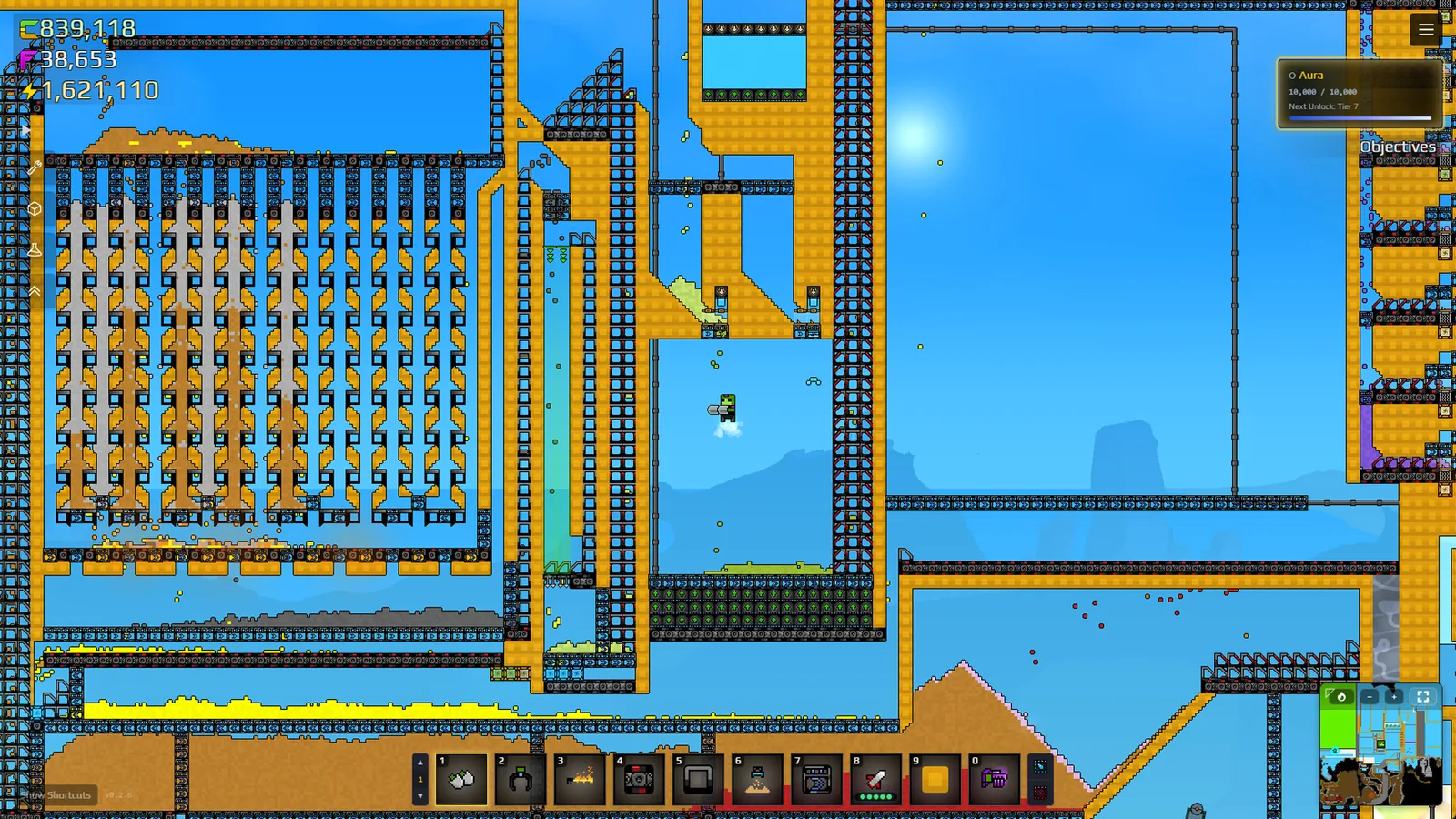
Minimum working chain
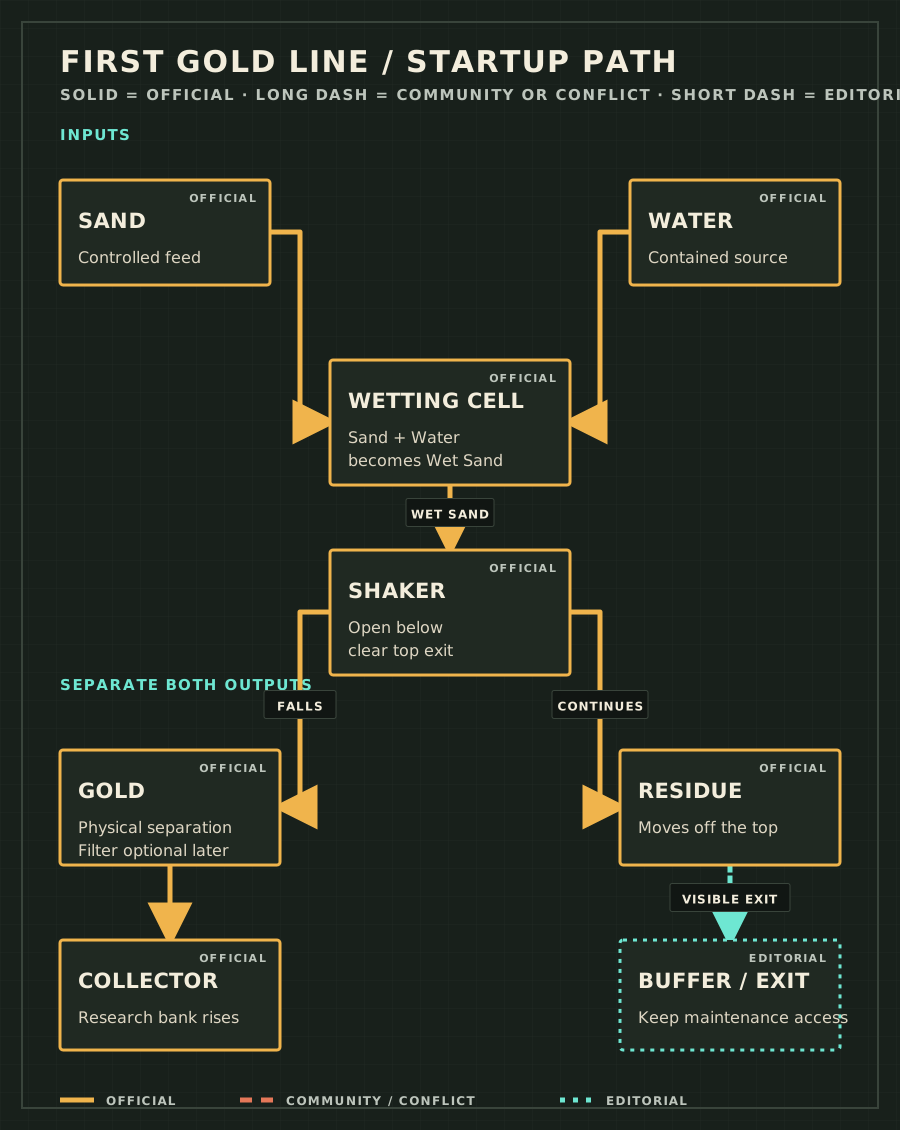
- Sand + Water
Use a small contained contact area; one Sand plus one Water becomes two Wet Sand.
- Wet Sand
Keep raw Sand out and send only the wetted stage toward the Shaker.
- Shaker
Place a short readable bank and start with one shallow batch.
- Gold leaves below
Keep the underside and lower route open.
- Gold reaches a Collector
Collector entry is the proof that visible Gold becomes Research currency.
- Residue leaves separately
Give the slow top output a side route and temporary buffer.
If any material path stops, use the four-path Shaker output diagnosis. After this minimum line succeeds, the main Filters guide explains optional sorting. When the first Gold reaches the bank, use the Research order guide to choose the next unlock instead of expanding every machine at once.
| Checkpoint | Success | Visible failure | Minimum correction |
|---|---|---|---|
| Wetting | Sand becomes Wet Sand in the contact zone. | Raw Sand reaching the Shaker | Slow Sand and extend Water contact. |
| Input | One shallow Wet Sand batch reaches the Shaker. | Wet Sand overflow or a deep pile | Stop feed and reduce batch depth. |
| Top output | Residue leaves separately. | Residue blocking top output | Clear the side and add buffer space. |
| Bottom output | Gold leaves below into its own route. | Gold is visible but trapped | Clear under the Shaker and the lower lane. |
| Collection | Gold reaches a Collector and the bank changes. | Gold not counting | Trace the final pixels into the Collector. |
Why a Filter is optional for the first setup
The Shaker already separates the two outputs physically: Gold can leave below while Residue remains on top. A Filter helps later when streams cross or contamination reaches the Gold lane, but it is not a necessary step between the Shaker and the first Collector.
Startup test before scaling
- Close continuous input
Begin with one shallow Wet Sand batch so the first failure remains visible.
- Watch the landing point
Confirm Wet Sand reaches the Shaker instead of raw Sand or overflow.
- Watch both exits
Gold must leave below and Residue must clear the top side.
- Watch the Collector
Do not call the line complete until Gold enters it and counts.
- Add one change at a time
Increase feed, extend the bank, or add an optional Filter only after the same startup test still succeeds.
| Symptom | Likely cause | Check and fix |
|---|---|---|
| Raw Sand reaching the Shaker | The wetting stage is incomplete. | Reduce Sand input and lengthen Water contact. |
| Wet Sand overflow | The input is too deep or misses the processing surface. | Pause input and restart one shallow batch. |
| Residue blocking top output | The side route or buffer is full. | Clear the upper side before restarting. |
| Gold stays below but does not move | The lower route is obstructed. | Clear a direct path to the Collector. |
| Gold not counting | It has not entered a Collector. | Inspect the Collector opening and final route. |
Update record
- 2026-08-24 — Retargeted the page to how players get their first Gold and added a direct Research-order boundary.
- 2026-08-23 — Put the minimum no-Filter chain first and made Collector entry the completion proof.
- 2026-08-22 — Removed Filter Research as a prerequisite and separated later Residue processing.
Frequently asked questions
Does the first Gold line need a Filter?
No. A Filter is optional for the first working output. Keep Gold physically separate below the Shaker and add a Filter only if mixed material later enters that route.
Why is visible Gold not counting?
Gold must reach a Collector to count toward Research. Follow the lower route all the way into the Collector instead of stopping when Gold appears under the Shaker.
When should the line be scaled?
After one shallow startup batch shows Wet Sand reaching the Shaker, Gold leaving below into a Collector, and Residue leaving separately without blocking the top.